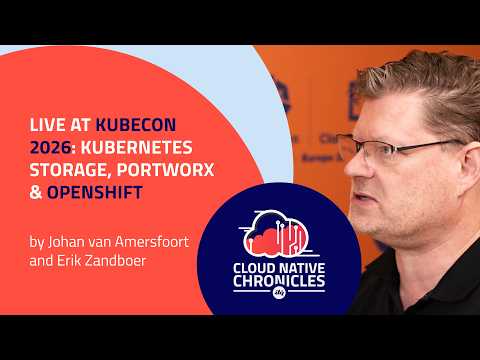
Recorded live at KubeCon 2026, Johan van Amersfoort (Chief Evangelist and AI Lead at ITQ) sits down with Erik Zandboer (Cloud Native Architect at Portworx) to explore one of the biggest challenges in Kubernetes: stateful workloads and storage.
While Kubernetes has become the standard for container orchestration, it was never designed for stateful applications. So what happens when organizations start running databases, AI workloads, and business critical applications on Kubernetes?
From scaling limitations of CSI to disaster recovery, hybrid cloud storage, and AI driven architectures, this episode breaks down how platforms like Portworx extend Kubernetes to support real world workloads.
In this episode they discuss:
• Why Kubernetes struggles with stateful workloads
• The limitations of CSI and when they become visible
• How Portworx enables scalable, Kubernetes native storage
• The role of OpenShift as a broader developer platform
• Storage architectures for AI workloads (block vs object storage)
• Disaster recovery and multi cluster replication
• How abstraction layers improve performance and flexibility across environments
Continue exploring Cloud Native Chronicles?
We recorded multiple Cloud Native Chronicles episodes covering platform engineering, AI, sovereignty, and real world use cases.
Explore the full series to get a broader view on where Cloud Native is heading and how organizations translate it into impact: https://www.youtube.com/@ITQConsultancy/podcasts
⸻
00:00 Introduction
00:45 Kubernetes and the challenge of stateful workloads
02:10 CSI limitations and scaling challenges
04:00 Portworx and Kubernetes native storage explained
06:00 OpenShift and the developer ecosystem
08:00 Storage strategies for AI workloads
10:30 Block vs object storage in practice
12:30 Disaster recovery and multi cluster setups
14:30 Real world use cases and performance optimization
16:30 Getting started with Portworx
18:00 Closing thoughts