AI is rapidly becoming a strategic priority across the public sector. Governments, municipalities and public organizations are actively exploring how AI can improve efficiency, accelerate processes and deliver better services to citizens.
From permit applications and citizen communication to traffic analysis and data processing, the potential is enormous.
At the same time, the complexity is growing just as fast.
How can public organizations innovate quickly without losing control over data, governance and sovereignty? How do you prevent long term dependency on external technology ecosystems? And how do you ensure AI projects move beyond experimentation into responsible production environments?
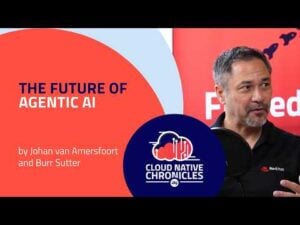
These were the central topics during an episode of the ITQ Private Cloud Café featuring Jan Saan, co founder of GLBNXT, and Tjerk Bakker, Sales Lead Public Sector at ITQ.
The public sector wants to innovate, but speed remains a challenge
According to Jan Saan, the public sector does not lack ambition, expertise or innovation potential.
The real challenge is speed.
Public organizations operate in highly regulated environments with critical responsibilities towards millions of citizens. That naturally creates longer decision making processes, stricter governance structures and a stronger focus on risk mitigation.
At the same time, standing still is no longer an option.
AI innovation is moving too fast. Organizations that remain stuck in strategy discussions without taking practical steps risk falling behind entirely.
AI is not primarily a technology challenge
One of the key insights from the discussion is that AI adoption is far less about models than many organizations assume.
The real challenge is data.
Where is the data stored?
Who has access?
What data can be used?
Which regulations apply?
And how do organizations maintain visibility and control?
Within many public sector environments, those questions are still difficult to answer consistently.
That is why the discussion around AI is increasingly shifting away from purely public versus private cloud conversations towards topics such as governance, sovereignty, control and flexibility.
Why Private AI is gaining momentum
This is exactly why Private AI is becoming increasingly relevant.
Private AI is not only about infrastructure. It is about maintaining control over data, governance, models and long term flexibility. Organizations want transparency around where data is processed, who can access it and how AI systems operate.
For public sector organizations, data sovereignty is quickly becoming a strategic requirement rather than just a compliance topic.
Because once organizations become fully dependent on a single vendor ecosystem, flexibility disappears.
And that creates long term risk.
One AI model for everything does not exist
Another important conclusion from the conversation is that many organizations still approach AI too generically.
In reality, not every use case requires a massive public AI model.
In many public sector scenarios, smaller and purpose built models are actually more effective, more efficient and easier to govern. Think about permit processing, document analysis or internal knowledge management.
According to GlobalNext and ITQ, this is where Private AI delivers real value.
Purpose driven AI models allow organizations to innovate faster while maintaining far greater control over performance, governance and operational complexity.
AI innovation requires smaller iterations
Traditional IT projects often took months or years before delivering visible results.
AI works differently.
Successful AI adoption requires short iterations, rapid experimentation and continuous improvement.
That creates tension inside many public organizations, because governance structures and approval processes are often still designed for slower, traditional project cycles.
But AI innovation moves much faster than traditional governance models were originally designed for.
That does not mean governance becomes less important.
In fact, governance becomes even more critical.
Successful AI adoption requires clear guardrails, strong data classification and well designed governance structures that support innovation instead of slowing it down completely.
Private AI does not have to be expensive or complex
There is still a common misconception that Private AI is automatically expensive, highly complex and only accessible for large enterprises or governments.
That is simply not true.
Not every organization needs a “Ferrari” level AI platform. Many use cases can run perfectly well on smaller, more focused AI environments designed for specific business outcomes.
By starting small, organizations can reduce risk, accelerate adoption and gradually scale AI capabilities in a manageable way.
And perhaps that is the most important takeaway from the discussion.
Successful AI strategies do not start with technology alone.
They start with awareness, governance, data control and the willingness to actually begin.
Want to explore how your organization can innovate with AI while staying in control of data, governance and sovereignty? Discover how ITQ Private AI helps organizations build scalable and future ready AI platforms.